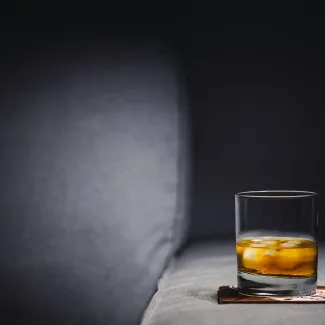
The heart of our club and the place to treat your taste buds!
Over the years, we’ve built up our whisky knowledge – and our collection, too. That’s why you can choose from more than 100 different whiskies here. Drop by for a small tasting sometime – we’ll help you find your favorite one.
Besides our cozy whisky lounge (open every Monday), we’ve got some bigger events coming up in our whisky bar – so stay tuned!
Want to learn more about whisky right now? We’ve put together plenty of info for you below. You can also browse our current whisky selection down there.
About the whisky bar
- A bar with 100 whiskies in a student club in Ilmenau – how did that happen?
-
In 1991, our club got an extra room. To have something unique compared to the other clubs, the idea of a Western bar was brought to life there – of course with whisk(e)y, though at first only 13 types, standard blends and bourbons. As travel and shopping options grew, Scottish single malt was discovered and brought in, the whisky range improved and expanded, and the Western theme was dropped. By 1993, the bar already offered more than 50 malts, kept growing and was bursting at the seams, so in 2000 it moved into the room we use today, which we set up ourselves and where the selection could grow to its current size.
- Are you the biggest whisky bar in Germany / Thuringia?
-
Unfortunately not – demand in Ilmenau and our budget are simply too small, and even in the bigger cities of Thuringia there are probably three or four larger ones. However, the size and quality of our selection are definitely on a high level, and thanks to our volunteer work the prices are unbeatable – for a student budget, there should hardly be a better place in Germany to get to know and learn to love good whisky.
- Why don’t you have whisky XYZ? How do you choose your whiskies?
-
We only have around 100 spots for more than 2,000 “candidates”, and there are about 100 Scottish distilleries alone, each with several bottlings. The different Scottish regions get their space, just like Ireland, the USA and the rest of the world. Around 50% of the bottles are relatively “fixed”, well-known and popular whiskies, plus about 25% other “important” distilleries whose bottlings may change. The remaining quarter is the most varied part: new whiskies and especially interesting bottlings are tried out, special offers are used – there is always something new to discover. Still, no whisky is ever really “safe”; every bottle has to earn its place again and again. Nothing would be more wrong – and more boring – than offering the same things all the time with such a huge variety out there.
- Where do you get your whisky from? Can I order a bottle as well? How much does that cost?
-
Most of our whisky comes from the online shop "The Whisky Store". You can also find their catalogues at the bar, and if you ask in good time, it is usually possible to add your own order.
Whisk(e)y – production and background
- What is whisky?
-
Basically, it is a spirit: plant material → alcoholic fermentation → distillation → high-proof alcohol. For whisky, the base material is grain, and at the end the distillate matures in oak casks for a certain amount of time.
What different types are there?
Scotch comes from Scotland and has matured in a cask for at least 3 years. It includes the very intense malts made from malted barley and distilled in copper pot stills, the soft and neutral grain whisky made from unmalted barley and other grains in column stills, and the mix of both, blended whisky (Johnny Walker & co.).
Irish whiskey is made in a similar way to Scotch. There is malt, grain and blend; a typical Irish style is pot still whiskey, where a mash of malted and unmalted barley is distilled in copper pot stills.
American whiskey is matured for at least 2 years in fresh (that’s the special part) oak casks. Here you have bourbon (at least 51% corn), rye (at least 51% rye), corn (at least 80% corn), malt (at least 51% malted barley), Tennessee (bourbon from Tennessee), and various blends.
Internationally, there are lots of different styles. Canada, for example, has very relaxed rules (rye whisky – rye – is often made mainly from corn, big amounts of additives are allowed, and so on), Japanese whisky follows Scotch rules quite strictly, in other Asian countries rice or molasses is used, and there are even whiskies made from buckwheat or chestnuts.
In our bar, we focus mainly on Scotch single malt – considered the “royal class” by many connoisseurs – and that is also what the rest of this section is about.
- How is Scotch single malt made?
-
Malting: Barley is soaked and spread on malting floors to germinate. During this process, the cell walls break down and starch and important enzymes are released. Kilning (drying), either directly with combustion gases from coal/peat or indirectly with heated air, stops this process.
Mashing: The ground malt (grist) is mixed with hot water in the mash tun, where the enzyme amylase turns the starch into malt sugar in several steps – the “wort” is created.
Fermentation: Yeast is added to the wort to produce the wash, and – similar to brewing beer – alcoholic fermentation turns the sugar into alcohol. After fermentation, the wash has around 5–8% alcohol.
Distillation: In large copper stills, unwanted compounds are removed and the alcohol is concentrated – first in the wash still to a rough spirit of about 25%, then in the spirit still to a fine spirit of about 70%.
Cask maturation: The fine spirit, diluted to 63.5%, goes into oak casks, where it has to mature for at least 3 years to be allowed to call itself whisky. The whisky oxidises, some of it evaporates (about 2% “angel’s share” per year), it draws the remains of the previous contents out of the wood and absorbs compounds from the oak.
Bottling: The finished whisky can be bottled straight from a single cask at its natural strength (cask strength), but often several casks (a batch) of different previous fillings and/or ages are blended and diluted to common drinking strengths (40/43/46%). For many standard bottlings, chill filtration and colour adjustment with caramel are common. As long as all of the whisky comes from one distillery, it is a single malt.
- Where do all those different aromas and flavours come from?
-
Ingredients: The quality of the barley (starch, protein and sugar content, germination rate), the water (pH value, microorganisms, minerals) and the yeast affect malting, mashing and fermentation. Besides alcohol, these stages produce lots of esters, aldehydes, acids and higher alcohols, many of which carry flavour.
Kilning: Smoke from directly fired kilns transfers aromas to the malt. Burning the organic parts of peat creates different phenolic compounds that give whisky its medicinal, smoky and earthy notes. Levels range from completely unpeated to more than 160 ppm phenol today, with 30–40 ppm being typical for heavily peated whisky.
Distillation: Heat and the catalytic effect of copper change the existing compounds; some are broken down, others formed. The shape of the stills (height, wall thickness, constrictions, angle of the lyne arm) influences which vapours rise and which run back down to be redistilled and maybe broken down. Indirect steam heating is more even and easier to control than direct coal or gas firing, which can burn solids or, if heated too quickly, create harsh aromas.
Casks: In Scotland, casks are usually reused, mostly ex-bourbon casks that give the whisky notes of vanilla, coconut and fresh fruit, and ex-sherry casks, which tend to bring aromas of ripe, sweet fruit and strong oak. The level of charring is important – usually higher for bourbon than for sherry – and so is cask size: the smaller the cask, the faster and more intense the maturation.
Casks are used for around 40 years. A third-fill 12-year-old Scotch in a sherry cask will take on far fewer flavours than the first fill. Such “tired” casks either need longer maturation or the whisky is moved to fresh casks for a few months of “finishing”. These days, port, Bordeaux, Madeira and other exotic wine casks are used for this, and in rare cases the whole maturation takes place in such casks.
Over the years, sharp, metallic notes in the spirit fade, aroma compounds change, remnants of the previous contents move from the cask walls into the whisky, and the wood releases lignin.
Older whiskies are therefore usually smoother and rounder, but also fuller and more complex in flavour.
Climate: Whisky definitely matures faster at higher temperatures, and with bigger temperature swings it “breathes” more, oxidises more and loses more angel’s share. Rough sea air is said to add a salty touch, and whisky maturing in old stone warehouses is supposed to turn out milder than in modern racked warehouses.
- What is better – independent or original bottlings? What is the difference?
-
Most Scottish malt is either bottled by the distilleries themselves under their own label with a typical design as single malt, or sold on for blended whisky production (usually within the same group). The company Diageo successfully markets some of its well-known brands as the “Classic Malts of Scotland”, and some lesser-known ones in a shared design as the “Flora & Fauna” series. All of these are called original bottlings.
Sometimes, surplus stock from distilleries, blenders or whisky brokers ends up with independent bottlers or retailers. These come in various sizes and qualities: some have large warehouses and can really select casks, some have access to good casks for finishing, and the smallest ones, the so-called “armchair bottlers”, basically just have a name – they buy whisky from bigger players and have it bottled under their own label.
Main differences OB/IB:
Batch size: OBs – especially 10–12-year-old standard bottlings – are usually made from many casks vatted together. The special character of individual casks gets lost, but the quality is reliably consistent. IBs – small batches from a few casks, all the way down to single casks – offer individuality and variety, but they sell out quickly and the next bottling will probably taste different.
Cask selection: IBs can rarely choose exactly which casks they get from distilleries. Often these are ex-bourbon casks that have been used several times and are not very highly regarded by some fans. At the same time, they often give especially fresh, tropical fruit notes and let the original distillery character shine through. And because IBs work with small batches, they can upgrade weaker casks with targeted finishing and create particularly interesting whiskies.
Natural presentation: OBs often shape their whisky to suit the mass market: chill filtration removes particles that might become cloudy at low temperatures and be seen as a flaw. Caramel is used to keep the colour consistent between batches, and the whisky is diluted to 40% or 43% to keep prices attractive. Many IBs skip colouring and filtration and offer their whisky at 46% or even cask strength (usually over 50%), letting drinkers dilute it to taste.
Bottom line: There is no simple “better”. Decide for yourself which price and which style of quality works for you and whether consistency or individuality matters more. And of course these are just trends – there are exceptions on both sides.
Whisky menu and enjoyment
- What do the columns mean?
-
- Special notes on (n)ew whiskies, bottlings that are no longer or hardly available (L/?) or special (b)argains
- Name of the distillery, name of the bottling, vintages, finishes or bottling style
- Bottler: original bottling – bottled directly by the distillery/owner; Classic Malts – a specially marketed series from Diageo; otherwise the names of independent bottlers
- Age: if given, the age of the youngest whisky in the bottle; estimates marked with a tilde (~)
- Alcohol strength
- Price for 4 cl – 2 cl is also possible on request
- Tasting notes: the smallest common denominator from our impressions, info from producers/retailers and some online tastings, a short profile in 50 characters; don’t worry, nobody is expected to smell or taste everything that is listed
- What is the point of splitting things into Speyside etc.?
-
These are the traditional Scottish whisky regions. The split mainly helps with orientation and doesn’t say that much about flavour, except that you can usually expect a lot of smoke from Islay. :-)
- How up to date is the menu?
-
In the year before these lines were written, we were able to offer more than 70 new whiskies. So please forgive us if the menu is not updated daily – we usually wait for a few new whiskies to arrive before we refresh it. That tends to be every 3–4 weeks.
- Water, coke, ice – how should whisky be drunk?
-
Our whisky is there to be enjoyed, not to get you drunk. A cheap supermarket bourbon or blend is better suited for mixing with coke. Ice stops the aromas from opening up and numbs your taste buds. A good single malt should be enjoyed at hand temperature, and for that we offer matching nosing glasses that, unlike heavy tumblers, concentrate the aromas and let your body heat warm the whisky.
If the whisky feels too “aggressive” or you can’t smell anything but alcohol, try a few drops of water. It not only makes it milder, it can also “unlock” the aromas – especially with cask strength whiskies over 50%, but there is usually some room for dilution at 43% or 46% as well.
Take your time – a dram of 4 cl can easily give you an hour of pleasure. Smelling it is already half the fun. Then take small sips and keep the whisky in your mouth for one second for every year it spent in the cask – and give it a good chew.
- Nobody can pronounce this – help?
-
Speyside - Späißait Isle of Islay - Ail of Aila Aberlour - Äberlauer Ardbeg Uigeadail - … Uhgedahl Arran - Ärren Auchentoshan - Oukentoschen Balvenie - Bällvenie Bladnoch - Blädnock Blair Athol - Blähr Ässell Bruichladdich - Bruichläddick Bunnahabhain - Bunnahäwen Bushmills - Baschmills Caol Ila - Kuhl Aila Clynelish - Kleinlisch Dalmore - Dallmore Dalwhinnie - Dällwinnie Edradour - Ädredauer Glen Garioch - Glen Gierieh Glen Scotia - Glen Skouscha Glendronach - Glendronnack Glenfiddich - Glenfiddick Glenmorangie - Glenmorränschie Knockando - Nockänduh Isle of Jura - Ail of Dschura Laphroaig - Lafreug Ledaig - Ledäig Macallan - Mä-Kellen Oban - Ouben Old Pulteney - Old Pulltenäi Royal Lochnagar - Reul Locknagga Talisker - Taalisker
Slàinte! (Cheers!)